
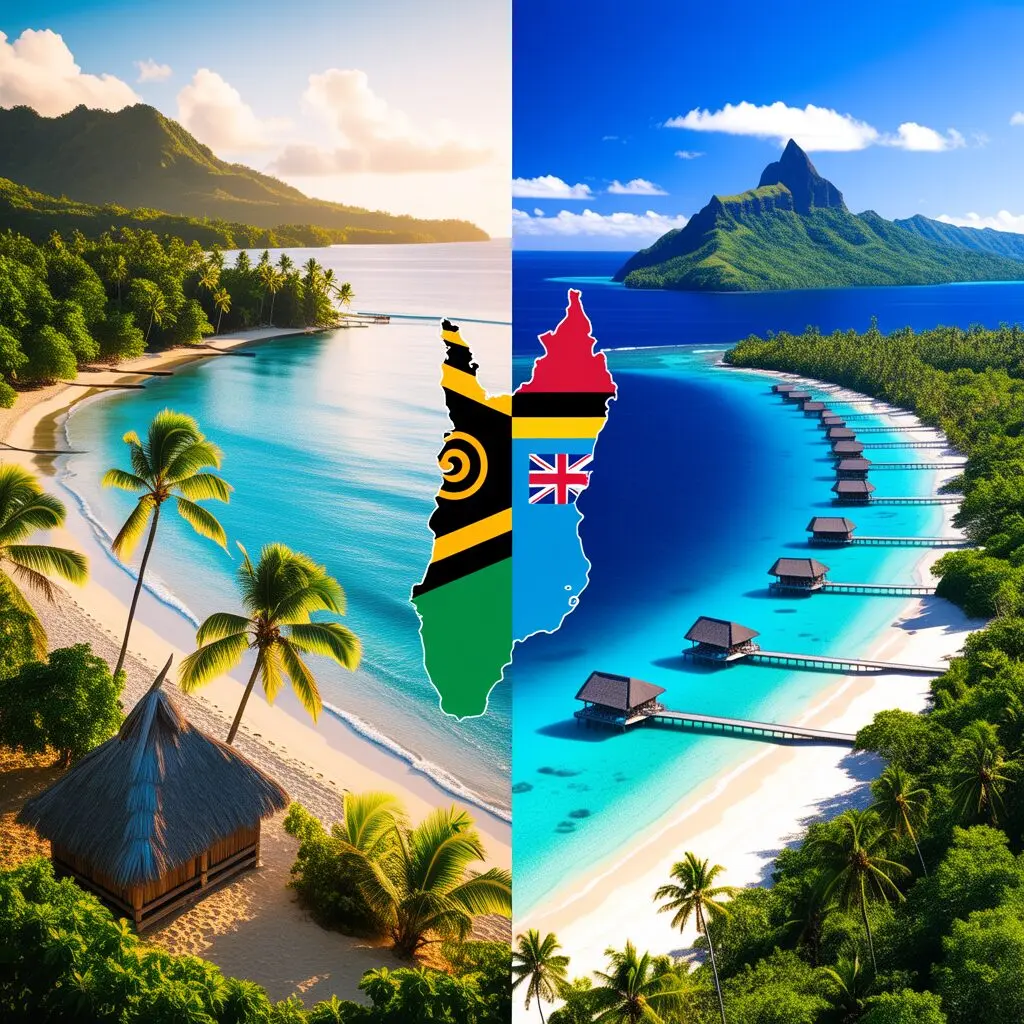
Vanuatu and Fiji are both Melanesian Pacific Island nations with similar visa exemption policies for most Western passport holders. Vanuatu requires an eVisa application at evisa.gov.vu for non-exempt nationalities (40 USD, up to 120 days), while Fiji follows its own Ministry of Immigration rules with exemption lists for over 100 countries and stays of up to 4 months. Passport power rankings place Fiji at #48 and Vanuatu at #51 globally, with mobility scores of 98 and 94 respectively. If you are planning a trip and need detailed information about Vanuatu specifically, see our complete guide to the Vanuatu eVisa.
Vanuatu vs Fiji Visa Overview
Both Vanuatu and Fiji offer visa-free entry to citizens of most Commonwealth nations, European Union countries, and several other Western nations. The key differences lie in stay duration limits and how non-exempt travelers apply for entry.
Vanuatu allows visa-free stays of up to 120 days for exempt nationalities, while Fiji permits stays of up to 4 months (approximately 120 days) for its exempt travelers. For non-exempt nationalities, Vanuatu operates an electronic visa (eVisa) system through the portal at evisa.gov.vu, whereas Fiji processes visa applications through embassies, consulates, or its online system managed by the Department of Immigration.
| Feature | Vanuatu | Fiji |
|---|---|---|
| Visa-free for Commonwealth | Yes | Yes |
| Visa-free for EU | Yes | Yes |
| Maximum stay (exempt) | 120 days | 4 months |
| Non-exempt application | eVisa online | Embassy or online |
| Tourist visa fee | 40 USD | Varies by nationality |
| Application portal | evisa.gov.vu | immigration.gov.fj |
Both countries are popular tourist destinations in the South Pacific, but their visa systems reflect different administrative approaches. Vanuatu has invested in a fully digital eVisa system, while Fiji maintains a hybrid approach combining embassy applications with online processing.
Passport Power Comparison
The Henley Passport Index and similar ranking systems evaluate passport strength based on visa-free travel access. Fiji holds a stronger passport position than Vanuatu in global rankings.
| Metric | Vanuatu | Fiji |
|---|---|---|
| Global rank | 51st | 48th |
| Mobility score | 94 | 98 |
| Visa-free countries | 51 | 54 |
| Visa on arrival | 43 | 44 |
| ETA required | 0 | 0 |
| eVisa required | 0 | 0 |
| Visa required | 104 | 100 |
Fiji’s passport provides access to 4 more visa-free destinations than Vanuatu, with the most significant differences in African and Middle Eastern countries. However, for travelers from Australia, New Zealand, the UK, the US, and most European nations, both countries offer identical visa-free entry conditions. For a detailed breakdown of Vanuatu’s passport power, see our Vanuatu passport power and visa-free travel guide.
Visa-Free Country Access
Vanuatu passport holders can travel without a visa to 51 countries and territories, with an additional 43 offering visa on arrival. Fiji passport holders enjoy visa-free access to 54 countries and visa on arrival in 44.
The overlap between the two countries’ visa-free lists is substantial. Both passports grant visa-free access to:
- All European Union member states
- United Kingdom and Ireland
- Most Caribbean nations
- Several Southeast Asian countries (Singapore, Malaysia, Philippines)
- Pacific Island nations (Samoa, Tonga, Solomon Islands)
The differences appear primarily in Africa and the Middle East, where Fiji’s slightly stronger diplomatic relationships provide additional visa-free or visa-on-arrival options. For a complete list of countries Vanuatu passport holders can visit visa-free, see our Vanuatu visa-free countries guide.
Entry Requirements for Travelers Visiting Vanuatu vs Fiji
Whether you choose Vanuatu or Fiji for your Pacific Island holiday, you will need to meet specific entry requirements at the border. While the core documents are similar, there are important differences in passport validity rules and documentation expectations.
Passport Validity
Vanuatu requires that your passport be valid for at least 6 months beyond your intended stay. This is a strict requirement enforced at immigration – travelers with passports expiring within 6 months may be denied boarding by airlines or refused entry at the border.
Fiji does not publish a specific minimum passport validity requirement in its official immigration guidelines. However, most international airlines enforce a 6-month validity rule as a standard policy for Pacific Island travel. Travelers should ensure their passport has at least 6 months validity to avoid issues with airline check-in.
Return Ticket and Proof of Funds
Both Vanuatu and Fiji require arriving travelers to hold a return or onward ticket. Immigration officers in both countries may ask for proof of sufficient funds to cover your stay, though neither government publishes a specific minimum amount.
For Vanuatu, travelers should be prepared to show:
- Return or onward airline ticket
- Recent bank statements or credit cards
- Accommodation booking confirmation
- Travel itinerary
For Fiji, the documentation expectations are similar:
- Confirmed return or onward travel
- Proof of accommodation
- Evidence of sufficient funds (typically bank statements or credit cards)
- Completed arrival card (distributed on the flight)
Vanuatu additionally requires a completed health declaration form, which may include vaccination verification depending on current health regulations.
Visa Fees Comparison
The cost of obtaining a visa differs significantly between the two countries, particularly for non-exempt nationalities.
| Fee Type | Vanuatu | Fiji |
|---|---|---|
| Tourist visa (exempt nationals) | Free | Free |
| Tourist visa (non-exempt) | 40 USD (5,150 VUV) | Varies by nationality |
| Business visa | 40 USD | Varies |
| Extension fee | Not available | Available (fee varies) |
| Payment methods | Online (credit/debit card) | Embassy or online |
Vanuatu’s eVisa fee is a flat 40 USD (approximately 5,150 VUV) regardless of nationality, paid online through a secure payment gateway at evisa.gov.vu. This straightforward pricing model makes budgeting for your Vanuatu trip simple.
Fiji’s visa fees vary by nationality and visa type, and are typically processed through Fiji embassies or consulates. The fee structure is less transparent than Vanuatu’s flat-rate system, and travelers may need to contact the nearest Fiji diplomatic mission for specific pricing.
For exempt nationalities visiting either country, there is no visa fee – you simply arrive and receive your entry stamp at the immigration counter.
Processing Time and Application Process
The application process and processing times represent one of the clearest differences between the two Pacific Island destinations.
Vanuatu eVisa Processing:
- Application submitted online at evisa.gov.vu
- Standard processing: 3-14 working days
- Approval notification via email
- Must be obtained before travel (no visa on arrival for non-exempt)
Fiji Visa Processing:
- Application through embassy, consulate, or online
- Processing time: typically 10-15 working days
- Some nationalities may apply on arrival (limited cases)
- Embassy processing may take longer depending on location
Vanuatu’s fully digital eVisa system offers several advantages for travelers. The online application can be completed from anywhere with an internet connection, documents are uploaded digitally, and payment is made online. This eliminates the need to visit an embassy or mail physical documents.
Fiji’s hybrid system requires embassy visits for many nationalities, though online applications are increasingly available. Travelers in countries without a Fiji embassy may face additional delays due to postal processing times.
Which Is Easier to Visit – Vanuatu or Fiji?
For most Western passport holders (Australian, New Zealand, American, British, and European citizens), both countries are equally easy to visit with visa-free entry. The practical differences come down to flight connections and accessibility.
Flight Connections
Fiji’s Nadi International Airport serves as a major Pacific hub with significantly more international connections:
- Direct flights from Los Angeles, San Francisco, and Honolulu (USA)
- Direct flights from Sydney, Melbourne, Brisbane (Australia)
- Direct flights from Auckland, Wellington (New Zealand)
- Connections from Singapore, Hong Kong, and Tokyo
- Regional flights from most Pacific Island nations
Vanuatu’s Bauerfield International Airport in Port Vila has more limited connections:
- Direct flights from Sydney, Melbourne, Brisbane (Australia)
- Direct flights from Auckland (New Zealand)
- Regional flights from Noumea (New Caledonia), Fiji, and Solomon Islands
- No direct flights from the US or Asia
For travelers coming from North America or Asia, Fiji offers significantly easier access with direct or one-stop flights. Australian and New Zealand travelers have comparable options for both destinations, with multiple daily flights to Fiji and several weekly flights to Vanuatu.
Travelers who need to apply for a visa before visiting Vanuatu can follow our complete eVisa application guide for step-by-step instructions.
Frequently Asked Questions
What is better, Fiji or Vanuatu?
Both destinations offer unique Pacific Island experiences. Fiji has more developed tourist infrastructure, more flight connections, and a wider range of resorts. Vanuatu offers a more authentic, less commercialized experience with excellent diving, active volcanoes, and rich Melanesian culture. For visa purposes, both are equally accessible to most Western passport holders.
Do I need a visa for both Fiji and Vanuatu?
Citizens of most Commonwealth nations, EU countries, the US, and several other countries do not need visas for either Fiji or Vanuatu for tourism stays. Check the specific exemption lists for each country based on your nationality before traveling.
Is Vanuatu more expensive than Fiji?
Visa costs are minimal for exempt nationalities (free entry to both). For non-exempt travelers, Vanuatu charges a flat 40 USD eVisa fee. Fiji’s visa fees vary by nationality. Daily travel costs in Vanuatu tend to be slightly lower than in Fiji, particularly for accommodation and dining outside resort areas.
How powerful is a Vanuatu passport?
The Vanuatu passport ranks 51st globally with a mobility score of 94. It provides visa-free access to 51 countries and visa on arrival in 43 additional countries. This makes it the strongest passport in the Melanesian region, though slightly behind Fiji (48th) and well behind Australia and New Zealand.
Can I visit both Fiji and Vanuatu on the same trip?
Yes, many travelers combine both destinations. Fiji serves as the main Pacific hub with connections to Vanuatu. You can fly from Nadi (Fiji) to Port Vila (Vanuatu) in approximately 2 hours. Both countries offer visa-free entry to most Western passport holders, making multi-country Pacific Island itineraries straightforward.