
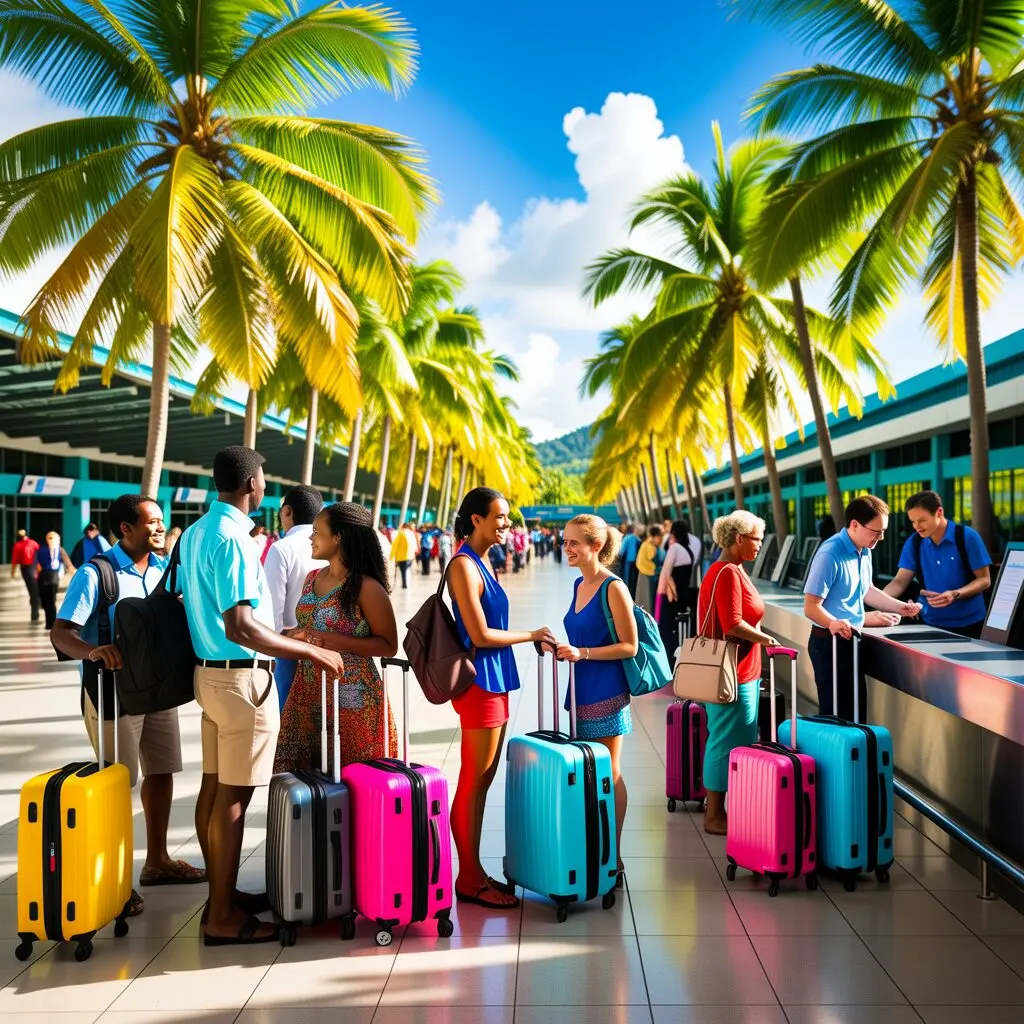
Vanuatu requires all visitors to hold a passport valid for at least 6 months beyond their arrival date, with at least one blank page for the entry stamp. Citizens of over 100 countries can enter visa-free for up to 120 days, while others must obtain an eVisa in advance. At the border, you will need to present your passport, a completed arrival card, proof of return or onward travel, and evidence of sufficient funds for your stay.
Passport Validity and Document Requirements
Vanuatu entry requirements start with your passport. The Department of Immigration and Passport Services requires that every arriving passenger holds a passport valid for at least 6 months beyond the date of arrival. This rule applies to all nationalities without exception. If your passport expires within 6 months of your arrival date, you will be denied boarding by the airline or refused entry at the immigration checkpoint.
Your passport must also contain at least one blank page for the entry stamp. Immigration officers at Port Vila (Bauerfield International Airport) or Luganville (Santo-Pekoa International Airport) will stamp your passport upon arrival, recording the date of entry and the permitted length of stay. Without a blank page, you may face delays or be turned away.
Blank Page and Passport Condition
Damaged passports – including those with water damage, torn pages, or illegible text – may be refused by Vanuatu immigration. If your passport is damaged, renew it before traveling. Emergency travel documents issued by your country’s embassy may be accepted in exceptional circumstances, but you should confirm this with the Vanuatu Department of Immigration before departure.
Dual Nationality – Which Passport to Use
If you hold dual nationality, you must enter and exit Vanuatu using the same passport. Presenting one passport on arrival and a different one at departure creates inconsistencies in the immigration system and may result in fines or delays. Choose the passport that gives you the most favorable visa conditions and use it consistently throughout your trip.
Visa Requirements by Nationality
Vanuatu’s visa policy is straightforward for most travelers. Citizens of over 100 countries – including Australia, New Zealand, the United States, the United Kingdom, Canada, Japan, Singapore, and all EU member states – can enter Vanuatu without a visa for stays of up to 120 days. This visa exemption is granted at the border and requires no advance application.
For a complete breakdown of visa-exempt countries and application procedures, see our Vanuatu eVisa guide.
Visa-Exempt Countries (100+)
The following table shows key visa-exempt nationalities and their permitted stay duration:
| Region | Countries | Maximum Stay |
|---|---|---|
| Australia & New Zealand | All citizens | 120 days |
| United States | All citizens | 30 days |
| United Kingdom | All citizens | 120 days |
| European Union | All 27 member states | 120 days |
| Canada | All citizens | 120 days |
| Japan | All citizens | 120 days |
| Singapore | All citizens | 120 days |
| Fiji | All citizens | 120 days |
US citizens should note that their visa-free stay is limited to 30 days, which is shorter than most other exempt nationalities. If you plan to stay longer than 30 days, you will need to apply for an extension or a visa before arrival.
Non-Exempt Countries – eVisa Application
Citizens of countries not on the visa-exempt list must apply for an eVisa through the official portal at evisa.gov.vu before traveling. The eVisa application requires a valid passport scan, a recent passport photo, proof of accommodation, and a return or onward ticket. Processing typically takes 3 to 5 business days. You cannot apply for an eVisa at the port of entry – it must be obtained in advance. For travelers from non-exempt countries, check the full application process in our visa on arrival guide.
Arrival Card – How to Complete It
Every visitor to Vanuatu must complete a passenger arrival card. This card is distributed on the aircraft before landing or available at the immigration counter at the port of entry. The arrival card is a legal document, and all fields must be completed truthfully.
The card collects the following information:
- Personal details – Full name (as on passport), date of birth, nationality, passport number
- Flight details – Flight number, origin, date of arrival
- Accommodation – Hotel name or residential address in Vanuatu
- Purpose of visit – Tourism, business, transit, or other
- Health declaration – Current symptoms, recent travel to disease-affected areas
- Customs declaration – Goods being brought into Vanuatu, cash amounts exceeding AUD 10,000 or equivalent
Incomplete or false declarations can result in fines, confiscation of goods, or denial of entry. Fill out the card before reaching the immigration counter to speed up processing.
Return Ticket and Proof of Funds
Vanuatu immigration officers require proof of onward or return travel. This can be a confirmed airline ticket, a booking confirmation for a connecting flight, or evidence of cruise embarkation. Digital copies on your phone are generally accepted, but a printed copy is recommended as a backup.
You must also demonstrate sufficient funds to cover your stay. While there is no officially published minimum amount, immigration officers may ask to see a bank statement, credit card, or cash equivalent. A reasonable guideline is approximately USD 50 to 100 per day of your planned stay. Travelers who cannot demonstrate adequate financial means may be denied entry.
If you are staying with friends or family rather than in a hotel, carry a letter of invitation with the host’s name, address, and contact details. Accommodation proof strengthens your entry application even though it is not always requested.
Health and Vaccination Requirements
Vanuatu does not require mandatory vaccinations for most visitors. There are no COVID-19 testing or vaccination requirements as of 2026 – these were removed following the pandemic.
However, if you are arriving from a country with a risk of yellow fever transmission, you must present a valid yellow fever vaccination certificate. This applies to travelers coming from parts of Africa and South America. The certificate must show vaccination at least 10 days before arrival.
Recommended (but not mandatory) vaccinations for Vanuatu include:
- Hepatitis A and B
- Typhoid
- Tetanus and diphtheria booster
- Mosquito-borne disease prevention (dengue, zika)
The health declaration section of the arrival card asks about current symptoms and recent travel to disease-affected areas. Answer truthfully – false health declarations carry legal penalties.
Customs Rules – What You Can and Cannot Bring
Vanuatu customs regulations are one of the most overlooked aspects of Vanuatu entry requirements. Most travel guides skip this topic entirely, but understanding what you can and cannot bring into the country prevents delays, fines, and confiscation at the border.
Duty-Free Allowances
The following table outlines the duty-free allowances for travelers entering Vanuatu:
| Item | Allowance |
|---|---|
| Cigarettes | 200 cigarettes or 50 cigars or 250g of tobacco |
| Spirits | 1 liter of spirits or liqueur |
| Wine | 2 liters of wine |
| Perfume | Reasonable quantity for personal use |
| Gifts | Up to VT 50,000 in value (approximately USD 420) |
| Cash | Amounts over AUD 10,000 (or equivalent) must be declared |
Items exceeding these limits are subject to customs duty. Undeclared excess quantities may be confiscated and fines imposed.
Prohibited and Restricted Items
The following items are strictly prohibited from import into Vanuatu:
- Narcotics and illegal drugs – All controlled substances. Penalties are severe and include imprisonment.
- Firearms and ammunition – Requires a special permit from the Vanuatu Police Force. Importing without a permit is a criminal offense.
- Obscene material – Pornographic publications and media are prohibited.
- Certain agricultural products – Fresh fruits, vegetables, plants, and soil may be restricted to protect Vanuatu’s ecosystem. All such items must be declared and inspected.
- Endangered species products – Items made from protected animals or plants under CITES regulations.
Restricted items that require declaration but may be permitted with inspection include food products, animal products, and biological specimens. When in doubt, declare everything on your customs form – the penalty for failing to declare is greater than the penalty for declaring a restricted item.
Designated Ports of Entry
Vanuatu has designated official ports of entry where immigration clearance is available. You cannot enter Vanuatu at an undesignated location without prior authorization.
- Bauerfield International Airport (Port Vila) – The primary international gateway, receiving flights from Australia, New Zealand, Fiji, New Caledonia, and Solomon Islands. Full immigration and customs facilities.
- Santo-Pekoa International Airport (Luganville) – The secondary international airport on Espiritu Santo island. Receives limited international flights, primarily from Australia and New Caledonia. Immigration services available during scheduled flight arrivals.
- Port Vila Wharf – Cruise ship and cargo vessel clearance. Immigration available during cruise ship season (typically April to October).
- Luganville Wharf – Secondary seaport for cruise ships and yachts. Advance notification required for yacht arrivals.
All yachts and private vessels must notify the Vanuatu Department of Immigration before arriving at any declared port of entry. The vessel’s captain must provide a crew and passenger list to immigration authorities. Failure to notify in advance is an offense under Vanuatu law.
Transit Through Vanuatu
Travelers transiting through Vanuatu without leaving the international transit area at Bauerfield or Santo-Pekoa airports may not need a visa, depending on their nationality and the airline’s policy. Transit passengers who remain airside and have a confirmed connecting flight within 24 hours are generally exempt from immigration formalities.
However, if you need to clear immigration – for example, to collect and re-check luggage, change airlines, or stay overnight between flights – you must meet the same Vanuatu entry requirements as any arriving passenger. This means holding a valid passport (6 months validity), and if applicable, a visa or eVisa.
Transit rules vary by nationality and airline. Contact your airline directly to confirm whether you need to clear immigration for your specific itinerary.
If you are traveling with children, review our Vanuatu visa for families guide for specific documentation requirements. For a full overview of all visa categories, see our Vanuatu visa requirements page.
Frequently Asked Questions
What are the entry requirements for Vanuatu?
You need a passport valid for at least 6 months beyond your arrival date, with one blank page. Citizens of over 100 countries can enter visa-free for up to 120 days. All visitors must complete an arrival card and carry proof of return or onward travel.
Do US citizens need a visa for Vanuatu?
No, US citizens can enter Vanuatu without a visa for stays of up to 30 days. You need a valid US passport with at least 6 months remaining validity and one blank page for the entry stamp.
What do I need to bring to Vanuatu?
Bring your valid passport (6+ months validity, 1 blank page), proof of return or onward ticket, evidence of accommodation, and proof of sufficient funds. If arriving from a yellow fever risk country, bring your vaccination certificate.
How much money do I need to enter Vanuatu?
There is no officially published minimum amount, but immigration officers may ask for proof of sufficient funds. A guideline of USD 50 to 100 per day of your stay is reasonable. Carry a bank statement or credit card as evidence.
Do I need vaccinations for Vanuatu?
No mandatory vaccinations are required for most travelers. However, if arriving from a yellow fever risk country, you must present a valid yellow fever vaccination certificate. Hepatitis A, typhoid, and tetanus boosters are recommended but not required.
Can I transit through Vanuatu without a visa?
If you remain in the international transit area and have a confirmed onward flight within 24 hours, you may not need a visa. However, if you must clear immigration (to re-check luggage or change airlines), you must meet full entry requirements for your nationality.